Why Your Team Knows What to Do But Isn't Doing It
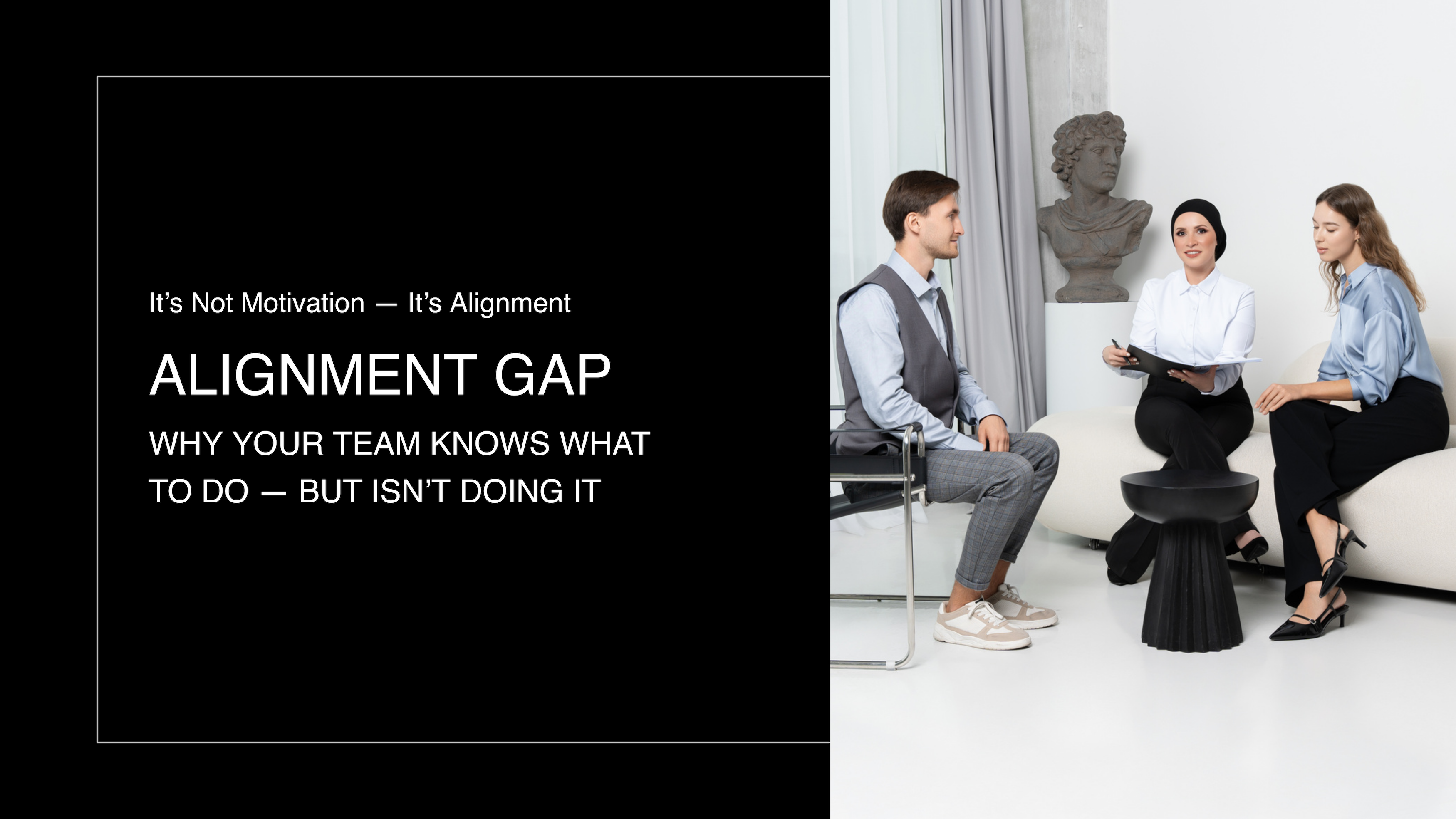
You've communicated the goals. You've explained the priorities. You've had the all-hands meeting, sent the follow-up email, and posted it in Slack for good measure.
And yet, three weeks later, nothing has moved.
Your team isn't confused about what needs to happen. They're confused about how it all connects.
The Problem Isn't Communication—It's Alignment
Most business leaders think the solution to slow progress is more communication. More meetings. More updates. More check-ins.
But here's what I've learned working with teams across Canada, the USA, and the UAE: communication without alignment creates noise, not progress.
Your marketing team has goals. Your sales team has goals. Operations has their own list. Everyone is working hard, heads down, executing their individual plans.
The problem? Those plans aren't connected to each other or to your larger business objective.
That's not a communication gap. That's an alignment gap.
What Alignment Actually Looks Like
Alignment means every person on your team can answer three questions clearly:
What am I working on? They know their specific responsibilities and current priorities.
Why does this matter? They understand how their work directly impacts team goals and business outcomes.
How does this connect to what others are doing? They see the relationship between their work and their colleagues' efforts.
When these three questions have clear answers, teams move fast. Decisions get made quickly because everyone understands the larger context. Collaboration happens naturally because people see how their work fits together. Motivation stays high because the purpose is obvious.
When those answers are unclear, everything slows down. People work hard but in different directions. Meetings multiply because no one is quite sure who needs to be involved in what. Frustration builds because effort doesn't translate to results.
The Cost of Misalignment
Misalignment is expensive in ways that don't show up on a balance sheet immediately.
It shows up when your best people get frustrated and start looking elsewhere because they can't see how their work matters. It shows up when simple decisions take weeks because no one knows who has authority to make the call. It shows up when you hit a growth ceiling because your team can't execute fast enough to scale.
I've seen businesses add more people to solve problems that weren't about headcount. They were about alignment. More people working in different directions just creates more complexity, not more results.
Building Alignment Into Your Team
Alignment doesn't happen by accident. It requires a systematic approach.
Start with a clear, shared purpose that everyone on your team understands and embraces. This isn't a mission statement that lives on your website. This is the answer to "Why does this business exist and what are we trying to accomplish together?"
From there, build transparent role clarity. Every person should know not just what they do, but how their role connects to others and contributes to shared goals. Overlap creates confusion. Gaps create dropped balls. Clarity creates momentum.
Then establish connected goals that cascade from your business objective down to department priorities and individual responsibilities. If someone can't draw a clear line from their daily work to your company's main goal, that line needs to be built.
Finally, create regular opportunities to assess and adjust. Alignment isn't a one-time achievement. Markets shift. Priorities evolve. Teams grow. What worked six months ago might not work today. High-performing teams build alignment into their rhythm, not just their strategy documents.
The Difference Alignment Makes
When teams are truly aligned, the change is obvious.
Decisions that used to take weeks get made in days because everyone understands the criteria and the direction. Collaboration improves because people naturally see how their work connects to others. Productivity increases not because people work longer hours, but because they're working on the right things in the right sequence.
Most importantly, your team stops feeling like a collection of individuals doing separate jobs. They become a unified force working toward a common purpose. That's when businesses scale. Not because they work harder, but because they work aligned.
Where to Start
If you're reading this and recognizing your team, you're not alone. Most businesses struggle with alignment at some point, especially during growth phases.
The question isn't whether you need better alignment. It's whether you're ready to build it systematically.
That's exactly what the People Alignment Process is designed to do. It takes the guesswork out of team building by providing a clear framework for creating purpose-driven, goal-aligned, high-performing teams.
Because your team doesn't need more motivation. They need more clarity. They don't need to work harder. They need to work aligned.
And that difference? That's what transforms good teams into high-performing ones.